Transparent, strong, and weather‑resistant – BOPP packaging tape has become an indispensable consumable in courier packaging, carton sealing, and e‑commerce logistics. Have you ever wondered how a jumbo roll of tape ends up as those low‑cost, high‑volume rolls we use every day? Below, we take a deep dive into an efficient BOPP packaging tape production line.
1. Market background
According to a 2025 report by Bezos Consulting, the global BOPP packaging tape market reached RMB 37.86 billion, of which China alone accounted for RMB 10.15 billion. The market is still growing – by 2032, global demand is expected to approach RMB 63.73 billion.
Regionally, Southeast Asia is emerging as a major growth area. In the first 11 months of 2025, Vietnam’s imports of jumbo tape rolls from China increased by 17.85% year‑on‑year. At the same time, the South China market is undergoing a structural shift from “inventory only” to “local production for local sales”. All these signals point to one conclusion: production efficiency and finished‑roll consistency are the key battlegrounds for producing standard clear tape at lower cost and higher quality for the global market.
2. Jumbo roll formation: the first step in the tape production line
BOPP packaging tape starts with the creation of a jumbo roll. This jumbo roll uses BOPP (biaxially oriented polypropylene) film as the substrate. The film undergoes a critical corona treatment – high‑voltage discharge raises its surface tension from about 38 dynes to over 52 dynes, ensuring that the adhesive bonds securely. The adhesive is then applied at a precise thickness of 15‑35 μm, dried, and wound into a semi‑finished jumbo roll.
Substrate preparation
The BOPP film is inspected for thickness, strength, and transparency, and any surface impurities or scratches are removed.
Corona treatment
Treatment intensity is tightly controlled to achieve consistent surface energy across the web. Inconsistent surface tension would cause large variations in initial tack and holding power on the same roll – leading to whole‑batch rejection. Over‑treatment can embrittle the film, causing splits during subsequent slitting.
Adhesive mixing and coating

A pressure‑sensitive adhesive – typically acrylic‑based, though natural rubber or hot‑melt resins may be used for special grades – is formulated and applied to the BOPP substrate via the coater. The coating section is the heart of the production line. Modern high‑speed BOPP coaters often use a comma knife coating head. The gap between the knife roller and the metering roller directly sets the coat weight, with micro‑level precision. A real‑time laser thickness gauge feeds data back to the PLC, which automatically adjusts the gap to prevent missed coating or adhesive buildup.
Drying and curing
The coated BOPP web enters a multi‑zone drying oven (e.g., four independent zones: a low‑temperature entry zone for skin formation, two high‑temperature middle zones for solvent evaporation, and a cooling exit zone to release internal stress). Hot air and optional infrared heating evaporate solvents and complete the physical and chemical curing of the adhesive layer. Improper temperature control can warp the substrate or prematurely age the adhesive; insufficient heat results in under‑cured adhesive, poor initial tack, and blocking between layers.
After these stages, a wide‑format jumbo roll (1.3‑1.6 metres wide) is precisely wound onto the rewind shaft, ready for slitting.
3. 4‑shaft automatic turret slitting: the core driver of cost and profit

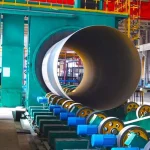
A BOPP jumbo roll can be up to 800 mm in diameter and weigh hundreds of kilograms. Converting it into retail‑ready rolls (widths such as 48 mm, 60 mm, or 72 mm) is called slitting.
Conventional two‑shaft slitters operate in a single mode: when shaft A is full, the line stops for several minutes while an operator blows off the finished rolls, manually inserts new paper cores, and reloads the cores. If this happens 40 times a shift, the accumulated downtime can easily be two hours of lost production per day. That is not just an annoyance – it is direct profit loss.
How the 4‑shaft turret technology boosts efficiency
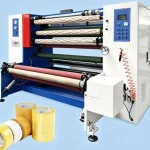
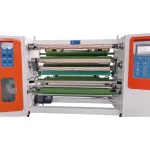
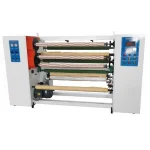
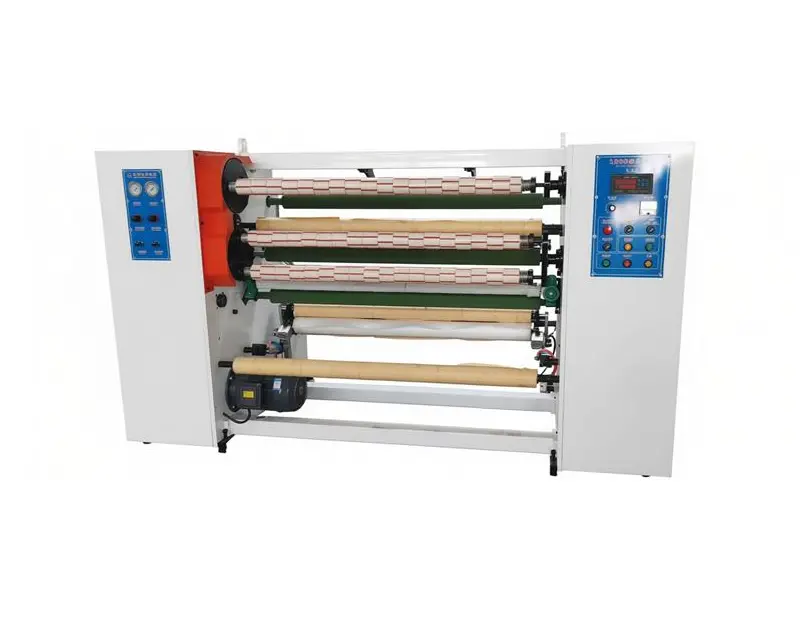
This is where a 4‑shaft automatic turret slitter creates a decisive competitive advantage. Four rewind shafts are arranged in two working pairs. While Group A is actively rewinding, Group B simultaneously completes finished‑roll unloading, core loading, and core insertion preparation. When a shaft in Group A reaches its set length, the turret rotates 120° and the next shaft instantly starts rewinding – with no manual intervention and almost zero gap time between rolls.
The continuous operation includes automatic finished‑roll ejection and automatic core loading on the standby shafts. Mechanical idle time is reduced to just a few seconds per cycle. For an OEM factory running 24/7, this translates into dozens of extra effective production days per year compared to using a conventional two‑shaft machine.
Beyond the non‑stop operation, the 4‑shaft turret slitter also excels at high‑speed cutting stability. The main motor (4 kW or 5 kW) drives the machine at speeds up to 260‑280 m/min. To eliminate vibration and resonance at these speeds, the frame is constructed from high‑quality 25 mm thick 45# high‑carbon steel, stress‑relieved and precision machined. This guarantees a stable cut – no chatter marks and no jagged edges.
The loading/unloading system uses shaft‑less pneumatic expanding shafts (both unwind and rewind). One operator can lock a multi‑ton jumbo roll or unload finished rolls in seconds, eliminating crowbars and clumsy locking devices.
Precision slitting and automatic labeling integration
Taking the Dalian Jiuying 1300mm 4‑shaft automatic turret slitter as an example, the working cycle is both intelligent and efficient:
- The jumbo roll is locked on the unwind stand.
- An automatic edge guide system tracks the web edge with ±0.08 mm precision.
- An entry anti‑wrinkle roller pre‑flattens the web, removing sag and distortion before it reaches the cutting station.
- Industrial razor blades slit the web into individual strips.
- Each strip is wound onto its own rewind shaft, with differential slip torque and individual magnetic powder clutches providing independent tension control for each slit strip. This avoids problems like telescoping or interlayer sticking.
- A three‑stage counter slows the machine before the target length, then stops it precisely – the length error is within ±0.1 metres.
- At the stop, a pneumatic cylinder drives a circular blade to cut the tape, and during the brief pause automatic labeling and roll surface smoothing are performed.
The entire sequence – from jumbo roll input to finished‑roll output – happens continuously, with minimal human intervention.
4. Value creation on the whole line: cost, quality, and delivery
The core of the BOPP packaging tape production line is the short loop formed by corona treatment → coating → drying → 4‑shaft automatic turret slitting. With the maturity of 4‑shaft turret slitting technology, an OEM factory can significantly increase its output per shift compared to older two‑shaft machines. At the same time, precision slitting ensures that every finished roll has clean edges and no paper dust leakage – this improves the resale value of the rolls and reduces returns and allowances.
When a complete, automated BOPP tape line is installed, response times for downstream orders are dramatically reduced. This is especially valuable for custom printed tape, 24‑hour emergency replenishment, and e‑commerce fulfilment.
The 4‑shaft turret slitter, when combined with an automatic servo tube inserter, automatic tube cutter, and automatic tube sorter, truly closes the gap from jumbo roll → precisely slit small rolls → automatic core insertion → finished‑roll unloading for packaging. This creates an “unmanned” seamless workflow, transforming labour‑intensive tape manufacturing.
In the end, the technological differences in BOPP packaging tape production lines are reflected in the final selling price and in the repeat‑purchase loyalty of customers.
5. FAQ
Q: What is the main difference between a 4‑shaft and a 2‑shaft slitter?
A: A 4‑shaft slitter turns manual operations (unloading finished rolls, loading new cores) into parallel automatic processes. Idle time is reduced from about every three hours to a few minutes per day, often doubling the output of the slitting section.
Q: What are the maximum and minimum slitting widths for BOPP tape?
A: On a typical 1300mm 4‑shaft slitter, the maximum working width is 1300 mm and the minimum stable slitting width is 12 mm. This covers mainstream e‑commerce packaging widths (48 mm, 60 mm) as well as narrow industrial splicing tapes.
Q: How do you maintain constant coating thickness?
A: Modern coating lines use a closed‑loop control system that integrates PLC central control, real‑time thickness feedback, and closed‑loop tension control. The adhesive is supplied to the comma knife under stable circulation, the coating gap is automatically compensated based on the exit‑side thickness gauge reading, and the entire process is digitally controlled.